Motivation
The construction sector in Central Europe must transition from linear to circular and digitally enabled models to meet environmental and economic challenges. However, many stakeholders lack the knowledge, skills, and coordinated support needed to implement circular and digital solutions effectively. There is also a gap between policy ambitions and practical implementation, especially across regions and sectors. This project addresses these challenges by strengthening capacities and cooperation within the construction ecosystem.
Objectives
The main objective is to increase awareness, knowledge, capacity, and skills related to circular and digital construction across Central Europe. This will be achieved through the development and testing of a comprehensive education and training programme. The project aims to support the transformation of linear business models into circular and sustainable ones. It also promotes cross-sector and cross-border cooperation among public authorities, industry, academia, and civil society.
Methodology
Combining research, stakeholder engagement, co-creation, and pilot testing. It starts with a comprehensive mapping of stakeholders, policies, good practices, barriers, and educational needs in the circular and digital construction ecosystem. Based on this assessment, tailored training concepts are developed for different target groups and tested through pilot activities. The results are consolidated into a long-term training framework and a Massive Open Online Course (MOOC) to ensure sustainability and broad accessibility.
Activities
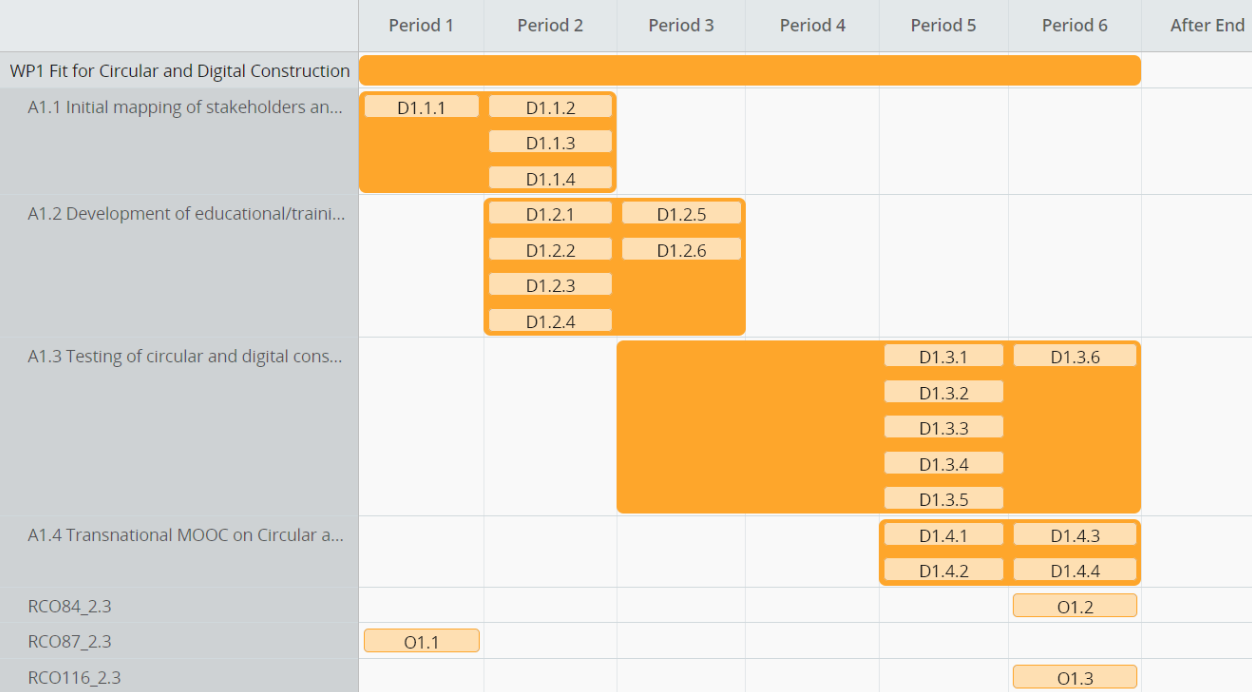
Activity 1.1 Initial mapping of stakeholders and the State-of-the-Art in central European construction and spill-off sectors
The initial mapping provides a comprehensive assessment of innovation ecosystems for sustainable, circular and digital construction in Central Europe, including related sectors such as waste management and agriculture. It covers industry, academia, government, civil society and environmental aspects across rural and urban areas. The assessment identifies key stakeholders, relevant policies and legislation, good practices, barriers, potentials and educational needs for circular construction.
Deliverables
D1.1.1 Tailored-made programme concept note for training of industry, including SMEs
The initial concept note for tailor-made trainings of industrial stakeholders (e.g. waste holders, recyclers, retailers, construction companies, construction products manufacturers) will be prepared to equip actors of the potential new values chain for circular and digital construction.
D1.1.2 Tailored-made programme concept note for training of industry, including SMEs
The initial concept note for tailor-made trainings of industrial stakeholders (e.g. waste holders, recyclers, retailers, construction companies, construction products manufacturers) will be prepared to equip actors of the potential new values chain for circular and digital construction.
D1.1.3 Conceptual note for activities needed for development of circular and digital construction
Based on the outputs of the initial mapping and workshops carried at the initial conference a conceptual note will be developed for further activities to strengthen transition to circular and digital construction in central Europe.
D1.1.4 Report on initial assessment of construction and spill-off sectors in the urban and rural areas
This deliverable will be e-report, available on the web-site of the ReBuilt project. It will serve as base for follow-up activities, development of innovative solutions in WP2 and development of demand-side measures and first Circular and Digital Construction Strategy in the central Europe (WP3).
Activity 1.2 Development of educational/training programme for circular and digital construction in central Europe
This activity develops a comprehensive education and training programme to support the transition to circular and digital construction. It targets students, public authorities, private entities, SMEs, architects and investors, promoting T-shaped expertise and cross-sectoral knowledge. A strong focus is placed on practical topics such as circular materials, legislation, digitalisation, business models and life cycle assessments, including a train-the-trainer approach to ensure long-term sustainability.
Deliverables
D1.2.1 Tailored-made programme concept note for training of industry, including SMEs
The initial concept note for tailor-made trainings of industrial stakeholders (e.g. waste holders, recyclers, retailers, construction companies, construction products manufacturers) will be prepared to equip actors of the potential new values chain for circular and digital construction.
D1.2.2 Tailor-made programme concept note for governments and public servants
The initial concept note for tailor-made trainings of public stakeholders (e.g. local, regional, national governments) will be prepared to equip them with knowledge and capacities for circular and digital construction (the latest SoA in technologies, materials, Green Public Procurement, EPD etc.).
D1.2.3 Tailor-made programme concept note for university and vocational students
Students, the future experts and decision-makers also need to receive cross-sectoral knowledge and training on circular and digital construction. The topics to be included are R hierarchies in CE, circular technologies and materials, digitalisation, legislation, business creation.
D1.2.4 Tailor-made programme concept note for architects and investors
Architects and designers are protagonists of CE, specially bioCE, but they are also difficult to include in trainings on construction product legislation, good practices of CE, EPD, etc. Investors also need to be educated that recycled / reused products / construction works are of good quality.
D1.2.5 Stakeholders consultation workshops on ReBuilt education and training programme
At least 4 transnational workshops will be organised in order to get high quality feedback on proposed 4 concepts of trainings and to research opportunity of transnational educational/trainings programmes either on academic level or lifelong trainings.
D1.2.6 ReBuilt education and training programme for circular and digital construction
A document, which will serve as a “bible” for its testing and establishing transnational programmes for knowledge creation and capacity building. The programme Fit for Circular and Digital Construction will include details on 4 programmes + module Train-the-trainer.
Activity 1.3 Testing of circular and digital construction training programme – Fit for Circular and Digital Construction
This activity tests the developed training programme through transnational events for students, public authorities, industry representatives, architects and investors. The sessions cover circular principles, legislation, digitalisation tools such as BIM and material passports, and circular business models. A dedicated train-the-trainer event ensures the programme can be further disseminated and sustained.
Deliverables
D1.3.1 Internal trainings to pre-test the Fit for circular and digital construction
Management and internal communication; mapping for the initial assessment; co-creation of circular construction innovations; circular business modelling/value chains; digitalisation (BIM, platforms); strategy creation.
D1.3.2 Report on educational and training events – university programme
A document with summary of all educational and training events for students during the project implementation.
D1.3.3 Report on educational and training events – lifelong training programme
A document with summary of all educational and training events for industrial entities and SMEs during the project implementation.
D1.3.4 Report on educational and training events – public servants training programme
A document with summary of all educational and training events for public servants inside governments (local, regional and national) during the project implementation.
D1.3.5 Report on educational and training events – architects and investors training programme
A document with summary of all educational and training events for designers, architects, investors, supervisors, etc. during the project implementation.
D1.3.6 Summary report on all pilot activities for different stakeholders groups
A document summarizing all educational and training pilot activities for different intended target groups, including MOOC.
Activity 1.4 Transnational MOOC on Circular and Digital Construction in central Europe
This activity develops a transnational MOOC as the final outcome of the training programme testing. The MOOC builds on lessons learned from all training modules and will be available in national languages to ensure broad accessibility. It also includes content for the general public, such as illegal dumping of waste and sustainable construction practices, and provides training for future trainers.
Deliverables
D1.4.1 Developed concept of Fit for Circular and Digital MOOC
The concept will include all 4+1 modules of trainings (one on illegal dumping and sustainable construction for everyday user). The MOOC operation and exploitation will be already considered from the beginning in shaping concept. The MOOC will be reviewed by peers with external experts.
D1.4.2 Train-the-trainers on-line course
At least 15 trainers from the consortium and outside will participate on-line course. Before the training draft of the tutorial will be prepared. The trainers will also give feedback how to improve the MOOC.
D1.4.3 Testing of the Fit for Circular and Digital Construction MOOC with tutorials
Based on the outcomes of the peer-to-peer review and training events the final MOOC will be prepared for initial testing. At least 30 participants around the programme area will participate 4 weeks of the MOOC training. During the MOOC training participants will advance to the next level by quizzes.
D1.4.4 Summary report on final solution of jointly developed cross national training programme
Report on final solution on jointly developed cross national program training programme, including MOOC, called Fit for Circular and Digital Construction.
Output
The project strengthens cross-border cooperation among organisations working in circular and digital construction. It delivers the “Fit for Circular and Digital Construction” education and training programme, including tailored concepts for different stakeholder groups. Pilot training events and evaluation reports document the testing and refinement process. A multilingual MOOC ensures long-term knowledge transfer and supports continued capacity building beyond the project duration.