Motivation
Work Package 3 was designed to support the structural uptake of circular and digital construction in Central Europe by addressing both demand-side conditions and long-term strategic cooperation. Although circular solutions, recycled materials, and digital tools are increasingly available, their wider application is still hindered by weak implementation of Green Public Procurement, insufficient or inconsistent End-of-Waste criteria, fragmented policy approaches, and limited coordination across regions and stakeholder groups. At the same time, the transition towards circular construction requires not only technological innovation, but also supportive governance, practical guidelines, and stronger institutional capacities among public authorities, businesses, and intermediary organisations.
WP3 therefore aimed to create the enabling framework for this transition. Building on the knowledge generated in WP1 and WP2, the work package sought to translate project results into concrete demand-side measures, a shared strategic framework, and an operational hub network that can support long-term implementation beyond the project duration. In this way, WP3 contributed to strengthening policy alignment, improving decision-making, and ensuring that circular and digital construction solutions can be scaled up and embedded in regional and transnational practice.
Objectives
Project specific objective
- Development of joint strategy for circular and digital construction in central European region
- Development and partial testing of Common strategy for Circular and Digital Construction in central Europe and deployment of Regional Circular and Digital Construction Hub network.
Communication objective and target audience
- Boost the momentum for attitude and behavioral changes. Targets groups under C.2 selection will be included: local communities, regional and national public authorities, sectoral agency, infrastructure, NGOs, higher education and research organisations, education/training centers, schools, enterprises, SME, business support organisation, international organisation, general public.
Methodology
WP3 combined analysis, co-creation, strategic development, and pilot implementation. First, under Activity 3.1, the consortium reviewed existing national and regional Green Public Procurement approaches and End-of-Waste criteria relevant for construction, with particular attention to barriers and opportunities for circular public construction works. On this basis, the partners prepared improvement proposals and practical guideline packages on topics such as digital tools, legislation, LCA/EPD/PEF, circular business creation, and eco-design, thereby creating decision-support material for public and private stakeholders.
Second, under Activity 3.2, the consortium used a participatory co-creation approach to develop a Common Strategy for Circular and Digital Construction in Central Europe. This included transnational workshops with relevant stakeholders from public authorities, sectoral agencies, research organisations, NGOs, business support organisations, and the construction sector. The workshops served to validate needs, define strategic priorities, and jointly shape recommendations on materials, technologies, value chains, financial instruments, and regional hub structures. The final strategy was further discussed and disseminated through the final project conference and implementation-oriented follow-up activities.
Third, under Activity 3.3, the strategic framework was translated into practice through the establishment and pilot operation of a Central Circular Construction Innovation Hub and eight regional or national Circular Construction Hubs. These hubs were designed according to a common intervention logic and connected under one umbrella structure, while also reflecting the thematic specialisation of each region. Their pilot testing and feasibility assessment allowed the consortium to evaluate long-term operational perspectives and to prepare a sustainability model for continued network operation after the end of the project.
Activities
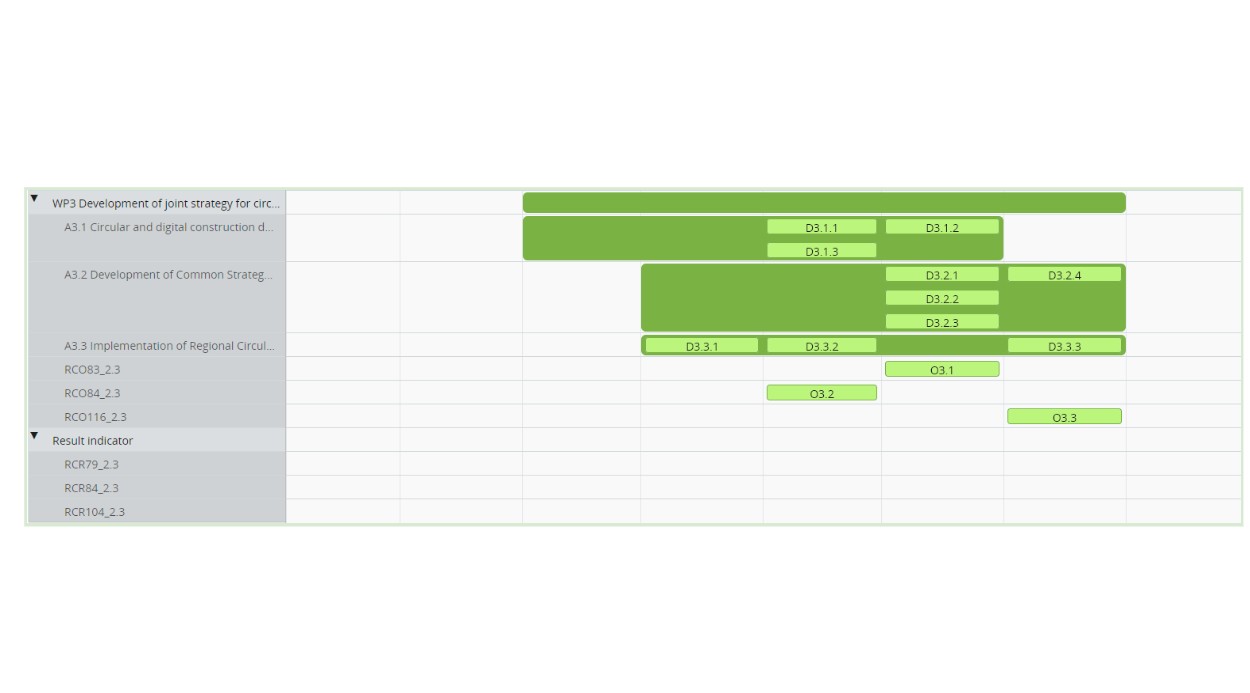
Activity 3.1 Circular and digital construction demand-side measures
Demand-side measures are one of most essential tools for transition into circular economy. Green Public Procurement (GPP) are developed in each region/country of the programme area but are poorly implemented, especially in the field of public construction works (buildings and infrastructure). At least 3 EU guidelines for GPP are essential for circular construction (Office Building Design, Construction and Management; Public Space Maintenance; Road Design, Construction and Maintenance) based on which recommendation for implementation of GPP will be made. Consortium will focus on to the review of existing End-of-Waste (EoW) criteria for different waste (e.g. CDW) and create a common proposal for new one. Both activities are connected with WP1/1.4, training of public servants, which need support for the decision-making. A CinderOSS platform, accessible through ReBuilt web-site, will be uploaded with GPP and EoW proposals. Led by PP7, all partners involved.
Deliverables
D.3.1.1 Report on review of national GPPs focused on construction and suggestions for new additions.
Report will include review of implementation of GPPs across the programme area and how they can be improved with dedicated documents on public procurement of office buildings/public space and road design, construction and management/maintenance. Report will focus also on LCA/LLC (costs), BIM tools.
D.3.1.2 Review of existing End-of-Waste criteria and proposal for new
EoW are critical for transition of waste into products. Several examples exists across central Europe some of good examples, while others more or less stopping use of recycled waste in construction due to high, non-realistic limit values. The report will give proposals for EoW of CDW.
D.3.1.3 Package of guidelines and tutorials
Development of 5 guidelines: Digital tools for circular construction (responsible PP, Environmental and construction legislation, LCA/EPD/PEF (Level(s)), Circular Business Creation, Eco-design, new materials and technologies. Led by PP9, all partner involved.
Activity 3.2 Development of Common Strategy for Circular and Digital Construction in central Europe
Based on lessons-learned in the project and acquired knowledge, the project consortium will in co-creation and cooperation with the relevant stakeholders developed a Common Strategy for Circular Construction in central Europe. Strategy will involve definition of goals, description of new materials and technologies raising for circular and digital construction, new business models, new value chains and financial instruments for achieving transition and implementation of circular construction in the programme area. 3 co-creative transnational workshops will be organized on-line in P5 with involvement of relevant stakeholders (e.g. local, regional, national governments, sectoral agencies, business support organisations, NGOs, higher education and research organisations) with at least 60 stakeholders involved. Special focus will be dedicated to the creation of regional/national Circular Construction Hubs, which will be promotors of circular construction. Led by LP1, all partners involved.
Deliverables
D.3.2.1 Workshops for development of common strategy for circular and digital construction in central Europe
At least 3 workshops (on-line/personal) will be organised in order to discuss the strategy framework.
D.3.2.2 Workshops for development of common strategy for circular and digital construction in central Europe
Publicly available on-line document
D.3.2.3 Final ReBuilt conference
The final conference will be organised in order to lunch publicly the strategy document and to harvest final comments on the content of the strategy.
D.3.2.4 Guidelines for implementation of Common Strategy for Circular and Digital Construction in central Europe
Meetings with public stakeholders (governments). CCIR office. Green Deal EC. GIAI-X
Activity 3.3 Implementation of Regional Circular and Digital Construction Hubs under Circular Construction Umbrella in central Europe
Based on lessons learned and in order to ensure long-term sustainability and continual transnational cooperation a Central Circular Construction Innovation hub (SI) with 8 regional/national Circular Construction Hubs will be created as promotors of circular construction industry in the central Europe. Hubs will follow the EIT structure of Innovation and RIS hubs with Innovation, Business creation and Academy pillars while each hub will also specialize in individual topics, as identified in each region as main potentials and needs, important for circular construction creation (e.g. HR legislation, IT – digitalisation, CZ – designing tools, HU – policies, AT – education, PL – demand-side measures, GE – new materials, SL – industrial symbiosis, SI – circular value chain and business models). Lead by LP1, all partners involved.
Deliverables
D.3.3.1 Report on initiation and operation of Regional Circular and Digital Construction Hubs
Report on establishment of Regional Circular and Digital Construction Hubs in Slovenia (LP1, PP2, PP3), Croatia (PP7), Hungary (PP8), Slovakia (PP11, PP10), Czech (PP13), Austria (PP6) and Bavaria (PP14) which be operated based on intervention logic of Academia, Entrepreneurship and Innovation
D.3.3.2 Report on pilot testing of Regional Circular and Digital construction hubs
Summary report on operation of pilot hubs on Circular and Digital Construction hubs in territory.
D.3.3.3 Long-term feasibility study for operation of Regional Circular and Digital Construction Hubs as SaaS
Report on developed SaaS with feasibility study – 5-y operational plan for Circular and Digital Construction Hub Network. Private and public funding is foreseen for the network operation. Hub operators will use OSS platform as the main tool for promotion of circularity and digitalisaiton. Developing and testing innovative solutions for circular and digital construction